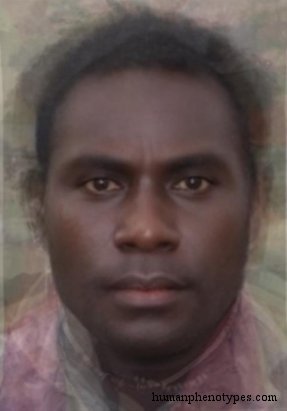
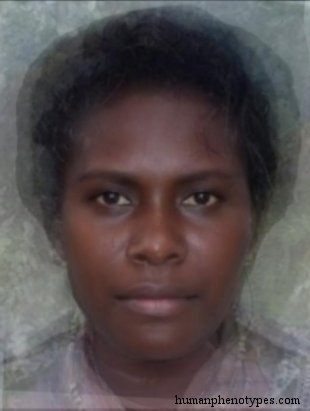
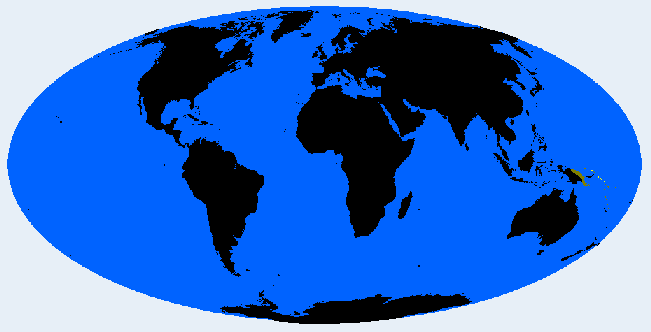
Melanesid variety, associated with the ancient "Walzenbeil" culture. Has sometimes been described as bantuiform, although no close genetic relationship to Africans exists. Dominant in the Western Solomons (e.g. Buka, New Georgia) and Bougainville as well as Nissan. Mixed in the Admiralty Islands, New Ireland, New Hannover, North-East New Guinea, and some other parts of Melanesia.
Physical Traits
Height: MediumBuild: MesoskelicBody type: Ecto- to mesomorphSkull: MesocephalicSkull height: Mildly hypsicranicFace: Relatively soft featuresNose: Straight or mildly convex, platyrrhineSupraorbital arches: MildSkin: Black, sometimes dark dark brown (darkest in Oceania)Palms: Dark (unlike African Blacks)Hair texture: Tight-curly / kinkyHair color: Black-brown, rarely blonde or red (especially in children)
Black, sometimes dark dark brown skin - the darkest in Oceania. Unlike in African Blacks, even palms are dark. Tight-curly / kinky hair that is black-brown, rarely blonde or red (especially in children). Medium-height, mesoskelic, ecto- to mesomorph. Mesocephalic, mildly hypsicranic. Straight or mildly convex, platyrrhine nose. Relatively soft facial features, supraorbital arches mild.
Geographic Distribution
Distribution map circa 1500 CE. Dominant in Western Solomons, Bougainville, and Nissan; mixed in other Melanesian regions
Literature References
Named and defined by Speiser (1938) and later used by Lundman (1952, 1967, 1988) after a Buka type had been recognized much earlier (Hagen, 1899). Eickstedt (1934) and Knussmann (1996) regarded it as a variety of Paleo Melanesid, Biasutti (1967) of Papua-Melanesid.