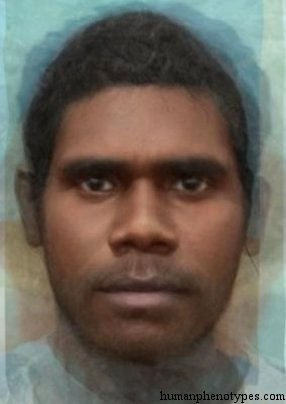
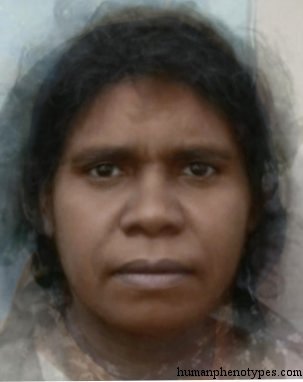
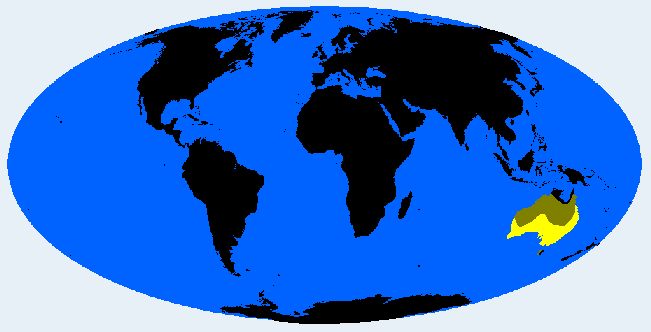
Australid subtype with proto-Caucasiform features associated with the people of the Murray basin of Southeastern Australia. Originally the most numerous Australid type, European settlers colonised the fertile lands of the South-East first and pushed back the natives. Today almost extinct in pure form, many mixed individuals remain. Was typical for Wiradjuri, Darling, Narungga, Wirangu, and related people.
Physical Traits
Skin: Medium to dark reddish-brownHair: Wavy to tight-curly, brown or blackHeight: MediumBuild: Brachyskelic, mesomorphSkull: Dolichocephalic, sometimes mesocephalicHead Shape: Chamae- orthocranic, large-headedNose: Platyrrhine but relatively high and longFace: Massive and robust, more so than other AustralidsOther: Strong supraorbital arches, deep-set eyes, receding forehead/chin
Medium to dark reddish-brown skin with wavy to tight-curly brown or black hair. Medium height, brachyskelic, mesomorph. Dolichocephalic, sometimes mesocephalic, chamae- orthocranic and large-headed. Nose platyrrhine, but relatively high and long. Face even more massive and robust than in other Australids. Supraorbital arches strong, deep-set eyes, forehead and chin receding, prognathy common, body hair strong.
Geographic Distribution
Distribution map showing presence in the Murray basin of Southeastern Australia, particularly among Wiradjuri, Darling, Narungga, Wirangu, and related peoples.
Literature References
The type was identified as Murrayian by Birdsell (1942), who speculated about relationships to Ainu. The type was adopted as Murra(y/i)an by other authors (Hooton, 1946; Coon et al, 1950; Cole, 1965). Lundman (1967, 1988) named it South Australid / Murrayid. Biasutti (1967) separated it as the Murray subrace.