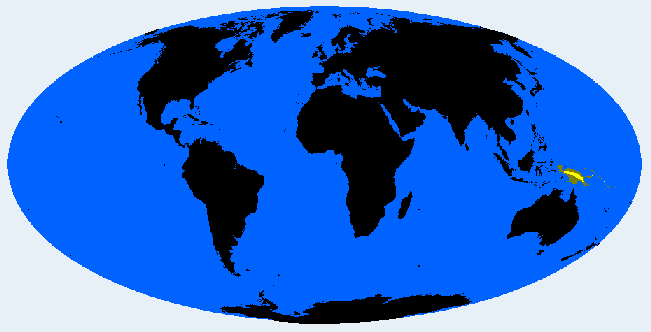
Description
Melanesian mountain variety, relatively ancient with similarities to Paleo Melanesid. Found mainly among New Guinean highlanders like Dani, Moni, Ekagi, Mbowamb, Enga, Paniani, Yali, and many others. Occasionally across the New Guinean lowlands and the hills of the Bismarck Archipelago (e.g. Baining) and Solomon Islands.
Historical Context
This type's distinctiveness was recognized early by Hagen (1899) as "Bergtypus" (mountain type). The highland adaptation and geographic isolation have preserved ancient Melanesian characteristics. These populations have developed unique cultural and physical traits suited to the challenging mountain environments of New Guinea's central highlands.
Physical Traits
Height: Rather short
Build: Mesomorph
Limbs: Very long arms and legs
Skull: Mesocephalic to brachycephalic, mildly hypsicranic
Head: Relatively large
Face: Robust and wide
Nose: Platyrrhine, relatively low or mildly convex
Skin: Usually dark, sometimes light brown
Hair: Tight-curly brown-black, sometimes lighter
Body hair: Strong
Usually dark, sometimes light brown skin with tight-curly brown-black hair that can be lighter in some cases. Mesomorph build with very long arms and legs despite rather short stature. Relatively large head that is mesocephalic to brachycephalic and mildly hypsicranic. Platyrrhine nose that is relatively low or mildly convex. Large mouth with thick lips, robust and wide face often with heavy brow ridges and deep-set eyes. Receding chin with common prognathism. Strong body hair.
Literature References
Its distinctiveness was recognised early by Hagen (1899) as "Bergtypus". Later studied by Le Roux (1948-1950) in higher detail. Thus, Biasutti (1967) classified it as a Mountain Papua subrace, some included in in Paleo Melanesid (Speiser, 1937; Weinert, 1965). Howells (1971) identified it as "group B1".