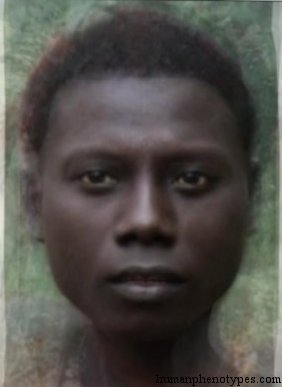
Isolated type typical for the Little Andamanese people (Onge, Jarawa, Sentilese). After contact with Europeans in the 19th century populations collapsed, mostly due to disease. A few hundred remain today with Jarawa being the most populous, and Sentilese one of the last Stone Age tribes without closer contact to the modern world.
Physical Traits
Skin: Bluish brown-blackHair: Kinky or peppercornHeight: Very shortBuild: Ectomorph to endomorph, mesoskelicSkull: Brachycephalic, mildly hypsicranic, small-headedNose: Mildly platyrrhineChin: WeakOther: Prognathy mild, females often steatopygic
Bluish brown-black skin, kinky or peppercorn hair. Very short, ectomorph to endomorph, mesoskelic. Body proportions show no sign of pygmyism. Females often steatopygic. Brachycephalic, mildly hypsicranic, small-headed. Mildly platyrrhine nose. Chin weak, prognathy mild. Compared to North Andamanid, more robust with a rounder face, wider nose, and shorter head.
Geographic Distribution
Distribution map showing presence among Little Andamanese people in the Andaman Islands, particularly Onge, Jarawa, and Sentilese populations.
Literature References
Eickstedt (1928) found Little Andanamese to be anthropometrically distinct from the Great Andamanese. Biasutti followed in recognising them as the Onghi subvariety (Biasutti, 1967). Detailed investigations by Cipriani (1956). Modern research confirms the genealogical distinctiveness of the two groups (Abbi, 2008). Often simply regarded as Andamanid (Lundman, 1967; Alexeev, 1979; Knussmann, 1996).